
Justin Allen - Nama Orang; Daniel Aquino - Nama Orang; Carlito Balingbing - Nama Orang; Martin Gummert - Nama Orang;
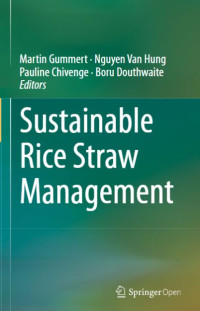
E-book Sustainable Rice Straw Management
Springer Nature · 2020
Penilaian
0,0
dari 5Informasi Detail Buku
ISBN/ISSN
9783030323738
Penerbit
Springer Nature
Tahun Terbit
2020
Halaman
199 hlm
Bahasa
English
Klasifikasi
333.7
No. Panggil
333.7 ALL s
Sinopsis
Rice straw is a residual byproduct of rice production at harvest. The total biomass of this residue depends on various factors such as varieties, soils and nutrient man-agement and weather. At harvest, rice straw is piled or spread in the field depending on the harvesting methods, using stationary threshers or self-propelled combine harvesters, respectively. The amount of rice straw taken off the field depends mainly on the cutting height (i.e., height of the stubble left in the field). Rice straw that remains in the field after harvest can be collected, burned, or left to decompose (soil incorporation). The “stubble”—the uncut portion of the rice straw after harvest—remains, and can be burned or incorporated into the soil in preparation for the next crop. The ratio of straw to paddy varies, ranging from 1.0 to 4.3 (Zafar 2015) and 0.74–0.79 (Nguyen-Hung et al. 2016a). We investigated biomass ratios for a com-mon rice variety (NSIC Rc158) at IRRI in 2017 that resulted in the findings shown in Fig. 1.1 (unpublished). Yield of the total straw biomass ranges from 7.5 to 8 t/ha while removed straw (harvested with leftover grains) ranged from 2.7 to 8 t/ha cor-responding to the cut portion ranging from 50% to 100% of the total straw biomass. Figure 1.2 shows the global minimum and maximum estimate of rice straw available bility based on global rice production data (IRRI 2019) and the straw:grain ratios of 0.5 and 0.7 from the experiment.Annual rice straw production is in the ranges of 100–140, 330–470, and 370–520 million t/year in Southeast Asia (SEA), the whole of Asia, and over the world, respectively. Utilization of rice straw is dependent on its characteristics, which can be divided into three major categories: (1) physical properties, (2) thermal properties, and (3) chem-ical composition. Physical properties include bulk density, heat capacity, and ther-mal conductivity.
Ketersediaan
#
Perpustakaan SMA Kolese Loyola Semarang
333.7 ALL s 003512-eB-0122
003512-eB-0122
Tersedia
Lampiran Berkas
Rekomendasi Buku Lainnya
0 BukuTidak ada rekomendasi buku yang ditemukan.