
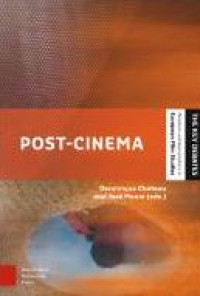
Dominique Chateau - Nama Orang; Jose Moure - Nama Orang;
E-book Post Cinema : Cinema in the Post-art Era
Amsterdam University Press · 2020
Penilaian
0,0
dari 5Informasi Detail Buku
ISBN/ISSN
9789463727235
Penerbit
Amsterdam University Press
Tahun Terbit
2020
Halaman
367 hlm
Bahasa
English
Klasifikasi
778.53
No. Panggil
778.53 CHA p
Subjek
Sinopsis
For some time now, in newspapers and books, a series of words keep ap-pearing that begin with the pref ix “post-.” As for these new words, the key to understanding seems to be a semantics of ambiguity. Post does not indicate something absolutely different but something in-between: postcapital-ism would be a new phase of capitalism; postmodernism, a new f igure of modernism; and post-history, history again. In all these cases, to the same question – does “post-” mean a clear break or the more or less identif iable result of an evolution? – the same answer arises: “post-” is a “problematic pref ix” that “debates over postmodernism and postmodernity taught us to treat not as a marker of def initive beginnings and ends, but as indicative of a more subtle shift or transformation in the realm of culturally dominant aesthetic and experiential forms” (Denson and Leyda 2016, 6).This astute remark can be found in Shane Denson and Julia Leyda’s introduction to Post-cinema: Theorizing 21st-Centur y Film, a high-quality collection of texts published in 2016. In addition to the editors, the contribu-tors include Lev Manovich, Steven Shaviro, Vivian Sobchack and Francesco Casetti. Considering this title and ours, it is obvious that the two projects look very similar. Apart from our call for new contributors and the fact that most of the texts in this volume are newly published or translated into American English (in Denson and Leyda’s book all the texts are republished in a more or less revised form), we can clarify the different points or nuances that specify our approach of the hypothetical notion of post-cinema.Not surprisingly, this differentiation is particularly notable in the subtitles (that are, in fact, most often used for this purpose): Denson and Leyda’s Theoriz-ing 21st-Centur y Film becomes our Cinema in the Post-art Era. Two crucial points can be made here: in the subtitle to this volume “cinema” seems to be rid of the embarrassing “post-” (which is, admittedly, contradicted in advance by the title); a second “post-” emerges at the same time as a new partner is introduced, art. Despite its sophisticated appearance, it means something very simple: we have chosen to focus the attention on the relationship between cinema and art, especially contemporary art and on the current transforma-tions of f ilms and cinema that attest to such a relationship. At present, it seems the practice of art is also seen through the same lens, pointing us in similar directions: art is supposed to have metamorphosed into post-art and thus is simultaneously non-art, or a kind of almost-art, quasi-art, may-be-art, and so on – at any rate, it is ambiguously identif iable as art. It so happens that cinema is part of this change and the resulting state of ambiguity.
Ketersediaan
#
Perpustakaan SMA Kolese Loyola Semarang
778.53 CHA p 005045-eB-0122
005045-eB-0122
Tersedia
Rekomendasi Buku Lainnya
0 BukuTidak ada rekomendasi buku yang ditemukan.