
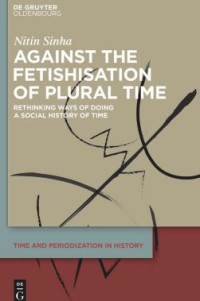
Nitin Sinha - Nama Orang;
E-book Against the Fetishisation of Plural Time
De Gruyter Saur ·
Penilaian
0,0
dari 5Informasi Detail Buku
ISBN/ISSN
9783111696492
Penerbit
De Gruyter Saur
Halaman
133 hlm
Bahasa
English
Klasifikasi
300.1
No. Panggil
300.1 SIN a
Sinopsis
This book raises three interlinked questions: first, how to do a social history of
time; second, what are the ways in which it can be done without succumbing to
the usual, and at times inevitable, pull of some of the useful binaries in which
most of the historical accounts of time have been written; and third, how, as a
result of overcoming some of these binaries, do we go beyond simply stating the
‘fact’ that time and/or temporality is plural and multiple when it is approached as
a socially-constituted entity. In raising these questions, the book problematises
the relationship between time and temporality and marks out the limitations in
the current historiography that deal with the making of the modern time. It argues for not using time and temporality interchangeably, which is not a novel
point in itself, but given the fact that the slippage between the two unwittingly
persists even in some of the highly useful recent works, it becomes necessary to
reiterate the difference. Rather than defining what time is, which is a philosophical and a physicist question, the book casts that inquiry into the historical mould
to explore how time, as a contestatory resource, becomes part of social relationships and what it does to them when scripts of power align themselves with the
control of time.1 Nitzan Lebovic has put it elegantly: ‘When one sets out to write
about time, one soon discovers it is a stubborn creature rejecting all forms of
characterisation. In fact, it is impossible to say what time really is: time cannot be
grasped through its affirmation (what time is) or its negation (what time is not).
Rather, it is more productive to think about time through its reception, its functions, its field of operations . . .’.2 Similar is the contention of another volume
which explains time as a function of coordination and rhythm but which also involves material, emotional, moral, and political dimensions.3 It is both punctuated
by extraordinary events like birth and death and ordinary routines of the everyday life
time; second, what are the ways in which it can be done without succumbing to
the usual, and at times inevitable, pull of some of the useful binaries in which
most of the historical accounts of time have been written; and third, how, as a
result of overcoming some of these binaries, do we go beyond simply stating the
‘fact’ that time and/or temporality is plural and multiple when it is approached as
a socially-constituted entity. In raising these questions, the book problematises
the relationship between time and temporality and marks out the limitations in
the current historiography that deal with the making of the modern time. It argues for not using time and temporality interchangeably, which is not a novel
point in itself, but given the fact that the slippage between the two unwittingly
persists even in some of the highly useful recent works, it becomes necessary to
reiterate the difference. Rather than defining what time is, which is a philosophical and a physicist question, the book casts that inquiry into the historical mould
to explore how time, as a contestatory resource, becomes part of social relationships and what it does to them when scripts of power align themselves with the
control of time.1 Nitzan Lebovic has put it elegantly: ‘When one sets out to write
about time, one soon discovers it is a stubborn creature rejecting all forms of
characterisation. In fact, it is impossible to say what time really is: time cannot be
grasped through its affirmation (what time is) or its negation (what time is not).
Rather, it is more productive to think about time through its reception, its functions, its field of operations . . .’.2 Similar is the contention of another volume
which explains time as a function of coordination and rhythm but which also involves material, emotional, moral, and political dimensions.3 It is both punctuated
by extraordinary events like birth and death and ordinary routines of the everyday life
Ketersediaan
#
Perpustakaan SMA Kolese Loyola Semarang
300.1 SIN a 005603-eB-0122
005603-eB-0122
Tersedia
Lampiran Berkas
Rekomendasi Buku Lainnya
0 BukuTidak ada rekomendasi buku yang ditemukan.