
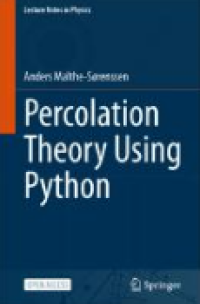
Anders Malthe-Sorenssen - Nama Orang;
E-book Percolation Theory Using Python
Springer Nature · 2024
Penilaian
0,0
dari 5Informasi Detail Buku
ISBN/ISSN
9783031599002
Penerbit
Springer Nature
Tahun Terbit
2024
Halaman
221 hlm
Bahasa
English
Klasifikasi
530.072
No. Panggil
530.072 MAL p
Sinopsis
n this chapter we motivate the study of disordered media through the example of a porous system. The basic terms in percolation theory are introduced, and you learn how to generate, visualize and measure on percolation systems in Python. We demonstrate how to find exact results for small systems in two dimensions by addressing all configurations of the system, and show that this approach becomes unfeasible for large system sizes. Percolation is the study of connectivity of random media and of other properties of connected subsets of random media [8, 30, 37]. Figure 1.1 illustrates a porous material—a material with holes, pores, of various sizes. This is an example of a random material with built-in disorder. In this book, we will address the physical properties of such media, develop the underlying mathematical theory and the computational and statistical methods needed to discuss the physical properties of random media. In order to do that, we will develop a simplified model system, a model porous medium, for which we can develop a well-founded mathematical theory, and then afterwards we can apply this model to realistic random systems. he porous medium illustrated in the figure serves as a useful, fundamental model for random media in general. What characterizes the porous material in Fig.1.1? The porous material consists of regions with and without material. It is therefore an extreme, binary version of a random medium. An actual physical porous material will be generated by some physical process, which will affect the properties of the porous medium in some way. For example, if the material is generated by sedimentary deposition, details of the deposition process may affect the shape and connectivity of the pores, or later fracturing may generate straight, open cracks in addition to more round pores. These features are always present in the complex geometries found in nature, and they will generate correlations in the randomness of the material. While these correlations can be addressed in detailed, specific studies of random materials, we will here instead start with a simpler class of materials—uncorrelated random, porous materials.
Ketersediaan
#
Perpustakaan SMA Kolese Loyola Semarang
530.072 MAL p 004767-eB-0122
004767-eB-0122
Tersedia
Rekomendasi Buku Lainnya
0 BukuTidak ada rekomendasi buku yang ditemukan.