
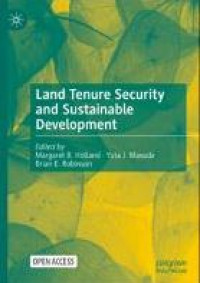
Rodrigo Arriagada - Nama Orang; Margaret B. Holland - Nama Orang;
E-book Land Tenure Security and Sustainable Development
Springer Nature · 2022
Penilaian
0,0
dari 5Informasi Detail Buku
ISBN/ISSN
9783030818814
Penerbit
Springer Nature
Tahun Terbit
2022
Halaman
353 hlm
Bahasa
English
Klasifikasi
301
No. Panggil
301 ARR l
Sinopsis
While trekking through the forests of Indonesia Borneo far from any urban center, the sound of insects, mammals, reptiles, and the roaring river can be deafening. It is a testament to the forest’s immense biodiver-sity—some of which is found nowhere else in the world. Yet no more than a few kilometers away, the forests open up to an expanse of oil palm trees that stretch to the horizon, neatly planted in rows like corn fields in central Indiana. This stark contrast in landscapes masks the tension around land ownership and land use in Indonesia Borneo that has lasted for several decades. Market forces fueled by policies that catalyzed demand for oil palm led to targeted increases in the production of oil palm. This led the way for international conglomerates to purchase hundreds of thousands of acres for oil palm production. But the lands being targeted for oil palm production were oftentimes occupied by local Dayak com-munities and others who have lived in the forests of Indonesia Borneo for generations, many of which settled the area there long before land titles. Indeed, in the 1980s, the Indonesian government recognized longstand-ing settlements and arranged systems whereby villagers could arrange a profit-sharing agreement with organizations interested in cultivating and developing the land in exchange for transferring development rights. But as an extensive New York Times piece (Lustgarten, 2018) documented, “companies often secured the permits they needed through some combi-nation of intense lobbying, bribery and strong-arming, and the result was broken promises and missing payments.” Villagers lacked the resources or institutional knowledge of how to defend their rights. Due in part to the power differential between villagers and international conglomerates and the enormous demand for oil palm, 16,000 square miles of rainforest have been lost since 1973, which accounts for approximately 20% of deforestation in impacted areas (Gaveau et al., 2016). The overall socio-economic impact of oil palm expansion remains difficult to generalize (Sheil et al., 2009), but increasing evidence suggests land ownership and land use remains central to concerns, conflict, and debate about increas-ing oil palm production and who ultimately benefits (Rist et al., 2010).
Ketersediaan
#
Perpustakaan SMA Kolese Loyola Semarang
301 ARR l 005200-eB-0122
005200-eB-0122
Tersedia
Rekomendasi Buku Lainnya
0 BukuTidak ada rekomendasi buku yang ditemukan.